


The Rhino marches for visibility and community in 1977.
The Rhino marches for visibility and community in 1977.
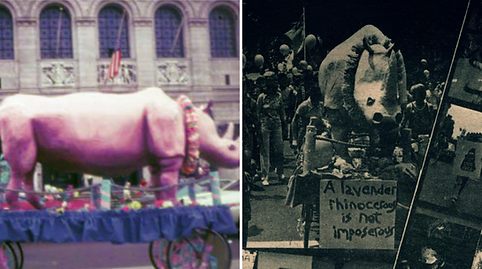
The Rhino marched for visibility and community in 1977.
Theatre Rhinoceros began with a roar
After the success of its first production, The West Street Gang by Doric Wilson — staged in the South of Market leather bar The Black and Blue — The Rhino moved into its first official home in the Goodman Building on Geary Boulevard, where it produced work until 1981.
From 1977 through the early 1980s, founder Allan B. Estes, Jr., built The Rhino into a fearless home for queer theatre. The company produced work by major New York writers, including Doric Wilson, Robert Patrick, Lanford Wilson, Terrence McNally, and Harvey Fierstein, as well as early one-acts that later became part of Fierstein’s Tony Award-winning Torch Song Trilogy. At the same time, The Rhino championed San Francisco playwrights such as C.D. Arnold, Robert Chesley, Cal Youmans, Philip Real, and Dan Curzon, while also bringing forward the work of lesbian writers including Pat Bond, Jane Chambers, and Adele Prandini.
This period of growth led to a 1981 move to the Mission District’s historic Redstone Building.
In 1984, Theatre Rhinoceros was forever changed by two defining events: the death of Allan B. Estes, Jr. from AIDS, and the premiere of The AIDS Show: Artists Involved with Death and Survival. Co-authored by twenty Bay Area artists, The AIDS Show was the first work by any theatre company in the nation to confront the AIDS epidemic. Directed by Leland Moss and Doug Holsclaw, the production ran for two years, toured the United States, and became the subject of a 1987 PBS documentary directed by Academy Award winners Rob Epstein and Peter Adair. The production brought national attention to The Rhino and remains one of the company’s most important and courageous achievements.
Under Artistic Director Kristine Gannon, from 1984 to 1987, The Rhino continued to grow as a theatre for both gay and lesbian voices. The company remained deeply committed to examining the impact of AIDS on the queer community, producing significant new works including Doug Holsclaw’s Life of the Party and The Baddest of Boys, Leland Moss’s Quisbies, Robert Pitman’s Passing, Anthony Bruno’s Soul Survivor, and the Henry Mach–Paul Katz musical Dirty Dreams of a Clean-Cut Kid.
The late 1980s brought new leadership and a broader vision of inclusion. Charles Solomon and Kenneth R. Dixon — the first African American to run a non-African American theatre — expanded The Rhino’s reach with work by African American, Chicanx, and queer playwrights, including Eve Powell’s Going to Seed, Cherríe Moraga’s Giving Up the Ghost, and a landmark interracial production of Mart Crowley’s The Boys in the Band.
During Adele Prandini’s artistic leadership from 1990 to 1999, The Rhino strengthened its reputation for artistic range, cultural diversity, and theatrical daring. The company produced work by Chay Yew, Guillermo Reyes, Wayne Corbitt, Sara Felder, The Five Lesbian Brothers, Split Britches, and Bloolips, while forging partnerships with organizations including Luna Sea, Teatro de la Esperanza, Black Artists Contemporary Cultural Experience, The Asian AIDS Project, and the Latino/a AIDS Festival. The Rhino received commendations from the City of Berkeley, the City and County of San Francisco, and the State of California on its fifteenth and twentieth anniversaries.
From 1999 to 2002, Artistic Director Doug Holsclaw led the company through another vibrant chapter, premiering new works by Marga Gomez, John Fisher, F. Allen Sawyer, Marvin White, Guillermo Reyes, and others. The Rhino’s twenty-fifth anniversary season celebrated world premieres by Johari Jabir, Sara Moore, John Fisher, Kate Bornstein, and Ronnie Larsen, along with special performances by Kate Clinton and Marga Gomez. During this time, Holsclaw also negotiated a contract with Actors’ Equity Association, making Theatre Rhinoceros the first gay theatre company to employ actors under a professional seasonal agreement.
Since 2002, Artistic Director John Fisher has continued to push The Rhino forward with work that is intellectually sharp, formally adventurous, and unmistakably queer. Critically acclaimed productions have included plays by Terry Baum, Marga Gomez, Erika Lopez, Martin Sherman, Nicky Silver, Tennessee Williams, George Bernard Shaw, and Fisher himself. Rhino productions have traveled to the New York International Fringe Festival, including Sara Moore’s Show Ho, Fisher’s Queer Theory and Schoenberg, and the audience-interactive There’s Something About Marriage.
The Rhino has also built important collaborations with major Bay Area institutions. In 2005, the company co-produced the U.S. premiere of Michel Marc Bouchard’s Lilies with the Tony Award-winning American Conservatory Theater, earning rave reviews and standing-room-only audiences.
In the years that followed, The Rhino continued to move boldly across genres, styles, and stages. Productions included new works, revivals, solo performances, musicals, political theatre, queer classics, holiday spectacles, and boundary-pushing collaborations with companies such as Word for Word and Eastenders Rep. The company staged work across San Francisco, from the Embarcadero to Potrero Hill, proving that The Rhino was not just a theatre company with a home — it was a theatre company with a city.
In 2008, Theatre Rhinoceros received a GLAAD Media Award for its landmark work as the longest-running professional queer theatre in the United States. The company also received recognition from civic leaders, including Nancy Pelosi, Carole Migden, Mark Leno, Tom Ammiano, and Gavin Newsom, during its thirtieth anniversary celebrations.
In 2017, The Rhino celebrated its fortieth anniversary as the longest-running LGBTQ+ theatre in the world. In 2019, the company was invited to march in the Resist Contingent of the San Francisco Pride Parade — right after Dykes on Bikes — in recognition of its long commitment to activism, visibility, social justice, and queer liberation.
Today, Theatre Rhinoceros continues its work from 4229 18th Street, in the heart of the Castro. From leather bars to national tours, from AIDS activism to contemporary queer storytelling, from emerging artists to theatrical legends, The Rhino has always been more than a stage.
It is a home.
It is a record of resistance.
It is a place where queer history speaks, laughs, fights, mourns, dances, and keeps going.